
November 4, 2026
Dual Durometer Technology:
The Engineering of Two Layers in Resilient Rubber Flooring
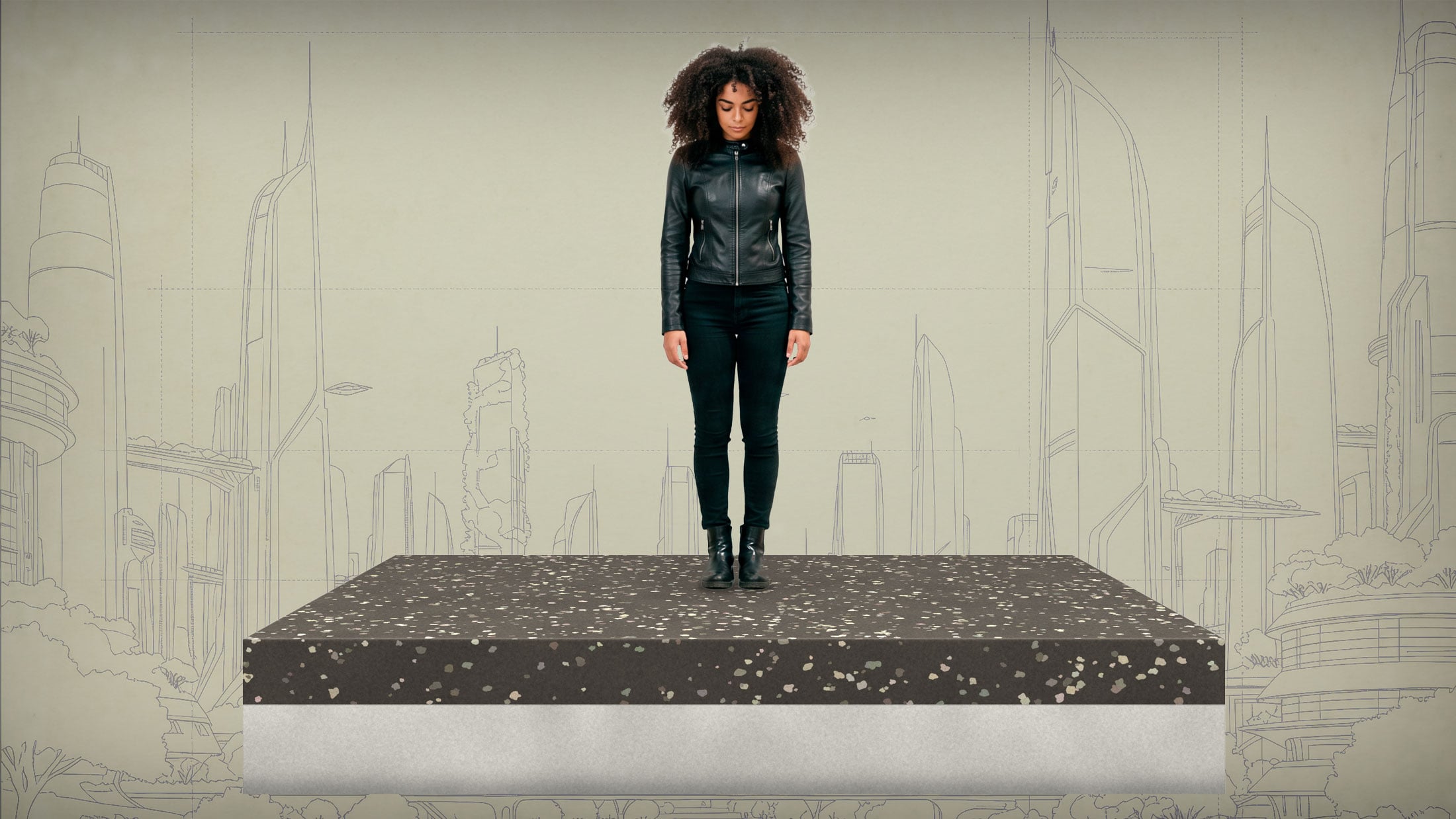
Dual Durometer technology is a construction solution that continuously and inseparably bonds two distinct layers of rubber with different Shore hardness levels through a molecular vulcanisation reaction.
The result is a single body consisting of a high-density surface layer designed to withstand abrasion and heavy loads, and a lower backing with controlled elasticity, intended for acoustic cushioning, comfort and the incorporation of recycled raw materials. In this way, the flooring overcomes a typical limitation of traditional resilient floors, removing the need to choose between protective rigidity and elastic flexibility while combining outstanding mechanical performance with ecodesign principles.
Where did the idea for Dual Durometer technology come from?
In flooring intended for high-traffic spaces (such as healthcare facilities, school complexes or commercial complexes), a uniform structure must meet conflicting requirements.
If formulated to be particularly rigid, it transmits impact sounds and tires people who walk on it for long periods. If it is too elastic, it risks compromising imprintability to indentation under concentrated loads.
Dual Durometer construction distributes these requirements across two distinct functional layers. The solution was originally developed by Mondo’s Sport division for high-performance athletics tracks — Mondo has been the official supplier to the Olympic Games for 12 consecutive editions since 1976 — and was subsequently introduced to the contract market in 2001. The principle lies in combining two complementary elastic behaviours within a single body.
Vulcanisation or lamination?
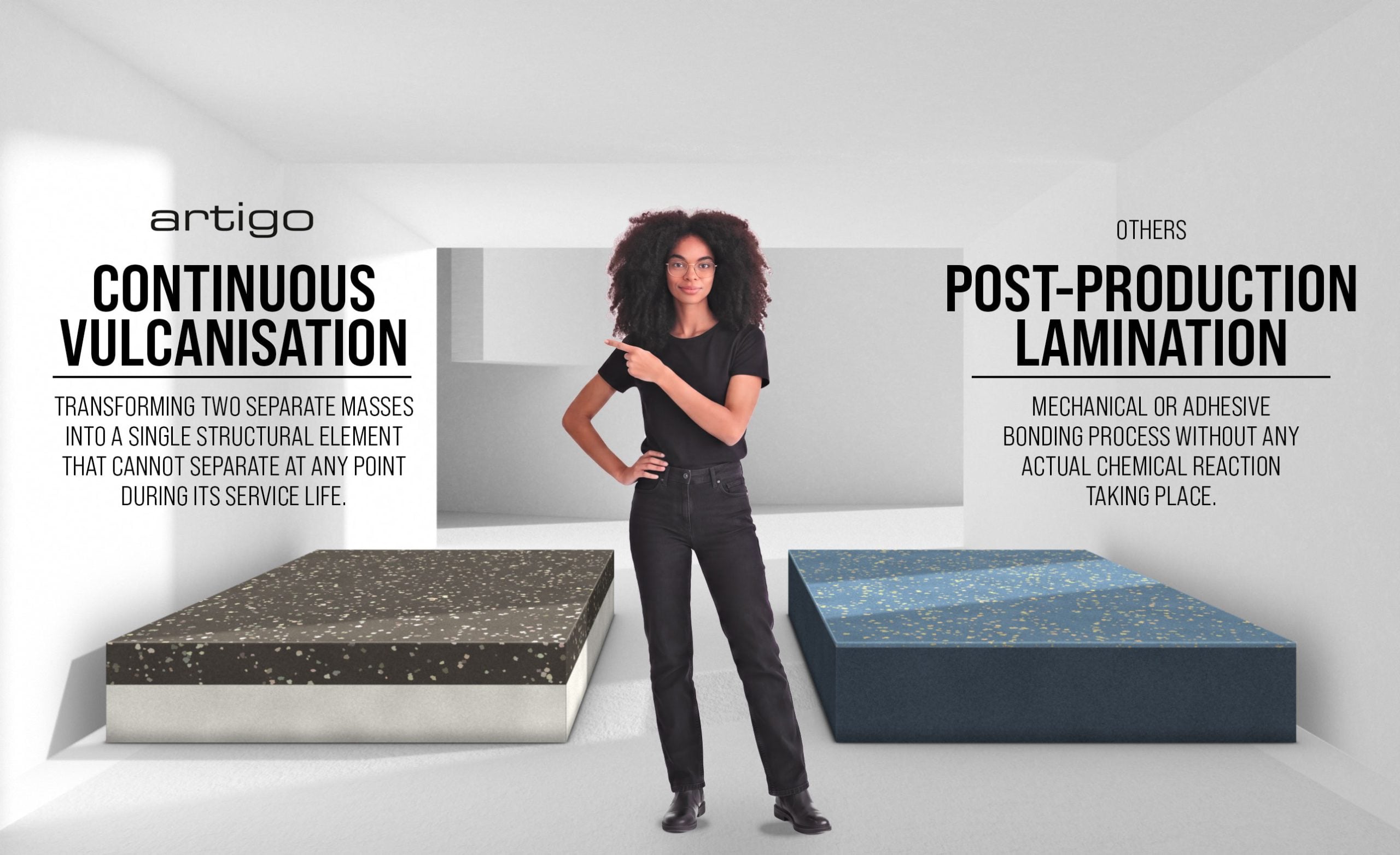
The key factor determining the performance of a multilayer surface is the method used to join its different components. In the resilient flooring market, two fundamentally different processes are used:
continuous vulcanisation
post-production lamination.
What is vulcanisation?
Vulcanisation is an irreversible chemical reaction in which raw rubber is subjected to high temperatures and pressures. Under the effect of heat, chemical bonds form between the polymer chains of the different rubber layers, transforming two separate masses into a single structural element that cannot separate at any point during its service life.
The different layers of Artigo rubber flooring are vulcanised together to deliver the properties of Dual Durometer technology with resistance comparable to that of a single-layer construction.
What is lamination?
Lamination, by contrast, is a mechanical or adhesive bonding process in which two sheets are joined using adhesive resins, localised pressure or superficial thermal micro-welding, without any actual chemical reaction taking place. Although it is an economical and widespread industrial technique, the absence of chemical bonds between polymer chains makes the joining interface a permanent weak point, susceptible to delamination, blistering or detachment due to moisture, temperature fluctuations or continuous rolling loads.
Performance anatomy: two coordinated layers
The cross-section of a Dual Durometer, such as the standard formulation with a total thickness of 3.0 mm, reveals an architecture calibrated for specific tasks:
Top layer (Wear layer)
The walkable layer has a nominal thickness of at least 1.0 mm and a Shore A hardness of 88 (measured according to ISO 48-4).
The Shore A scale measures a material’s empirical resistance to indentation, that is, the surface’s ability to resist local penetration by a calibrated steel tip under a controlled load. It is the standard reference for elastomers and flexible rubber and ranges from 0 (maximum penetration and extreme softness) to 100 (no penetration and maximum surface hardness).
A Shore A value of 88, as in Kayar vulcanised flooring, makes it possible to handle pedestrian traffic and light wheeled traffic directly. Unlike many competing resilient floors, which limit the decorative wear layer to around 0.2 mm over a compact 2.8 mm backing, the Dual Durometer construction provides five times the effective wear-layer thickness, with mineral fillers and fibres (such as coconut fibre in Kayar) distributed throughout the entire volume of the top layer.
The top layer of GAIA-version products allows the incorporation of polymers derived from vegetable oils and natural mineral fillers (at least 10% rapidly renewable content, as in eco-friendly contract ranges), directly contributing to the achievement of LEED credits.
The backing and circular value
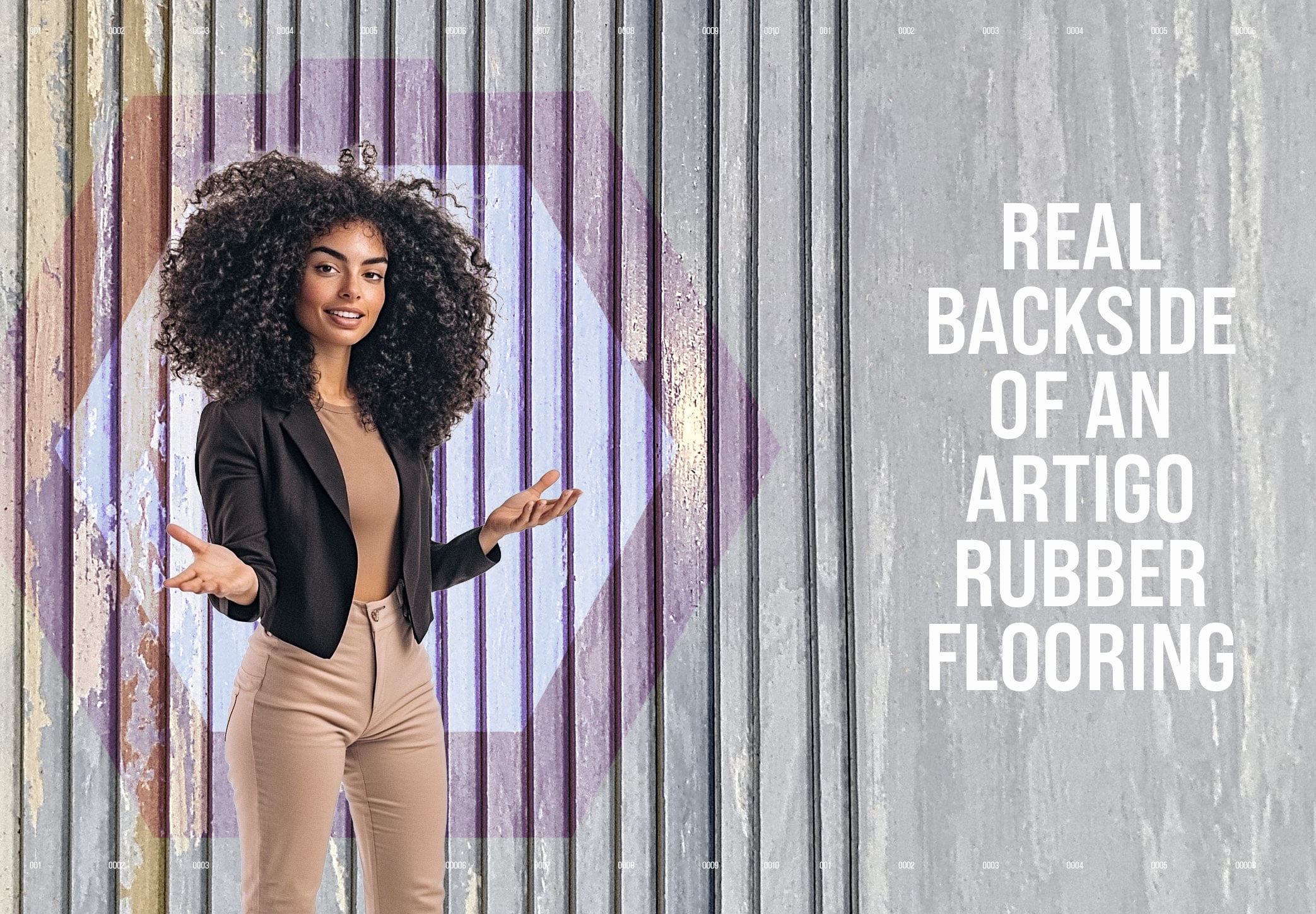
In resilient flooring design, ecodesign often comes into play where the eye cannot see. As we have already explained in the article entitled “The invisible importance of the backing, Dual Layer technology turns the bottom layer into a buffer for the circular economy:
- Industrial waste recovery: It makes it possible to reintroduce up to 20% of powder and cutting waste from pre- and post-production into the backing compound, avoiding landfill disposal without affecting the visible aesthetic appearance in any way.
- Chemical safety: The entire product remains compliant with European standards (EN 1817 and EN 12199), eliminates formaldehyde and volatile organic compound emissions (GREENGUARD Gold, Indoor Air Comfort Gold and Cradle to Cradle Silver certifications), and categorically excludes substances on the Living Building Challenge Red List, including PVC, phthalates, bisphenol A and per- and polyfluoroalkyl substances (PFAS).
CONTACT US!
"*" indicates required fields