

May 13, 2026
CO₂ equivalent: what it is, how it is calculated and why it matters more than CO₂ alone
In the language of sustainability, talking only about CO₂ is almost never enough to truly describe the climate impact of a product, process or company. This is why CO₂ equivalent is now used — a metric that makes it possible to aggregate the climate effect of the main greenhouse gases into a single value.
CO₂ equivalent calculation: what is it?
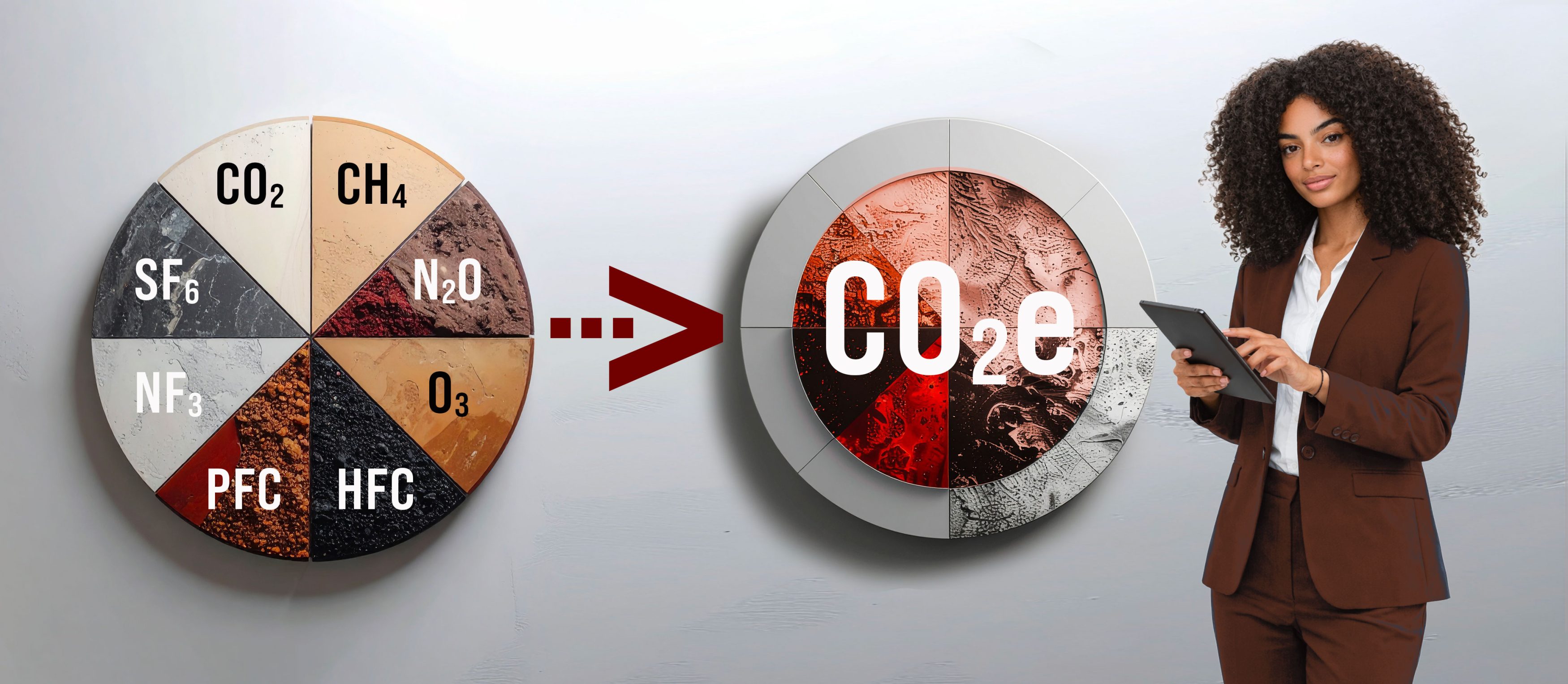
CO₂ equivalent, also indicated as CO₂eq., is a unit of measurement that translates the impact of different greenhouse gases into the equivalent amount of carbon dioxide needed to produce the same effect on global warming. This approach therefore makes it possible to compare different gases using a single reference scale based on the Global Warming Potential, or GWP.
In the technical context, CO₂eq. is the metric used to express the overall carbon footprint of products, activities and organisations. It is also the language used to interpret environmental indicators such as GWP in EPDs and Life Cycle Assessments (LCA).
How does it differ from the “traditional” CO₂ calculation?
There is a clear difference: CO₂ calculation measures only carbon dioxide emissions, while CO₂ equivalent calculation also includes other greenhouse gases, such as:
- methane;
- nitrous oxide;
- refrigerant gases and, more generally, all fluorinated gases.
Consequently, while pure CO₂ calculation provides only a partial picture, CO₂ equivalent calculation offers a much more comprehensive assessment of the real climate impact.
This distinction is important because not all greenhouse gases have the same ability to retain heat in the atmosphere. In practice, limiting the analysis to CO₂ alone can underestimate the environmental impact of a business activity or building material, especially when emissions other than direct combustion are involved throughout the supply chain.
The difference between CO₂, greenhouse gases and CO₂ equivalent
Human-induced climate change is caused by the release of various gases into the Earth’s atmosphere, known as greenhouse gases (GHG). The main one is carbon dioxide (CO₂), a gas emitted in large quantities whenever fossil fuels are burned. However, production, industrial and agricultural activities also release other gases with a much higher climate-altering potential, such as methane (CH₄), nitrous oxide (N₂O) and refrigerant gases.
To objectively measure and compare these substances, the United Nations Intergovernmental Panel on Climate Change (IPCC) developed the Global Warming Potential (GWP). This index evaluates the warming potential absorbed by a given quantity of a greenhouse gas over a specific period of time, usually 100 years, compared with the same mass of CO₂. For example, when evaluating the impact over a century, methane has a polluting capacity 28 times greater than CO₂, while nitrous oxide (N₂O) is approximately 265 times more powerful.
Since a single element or industrial activity can cause the emission of a combination of greenhouse gases in varying quantities, measuring them individually would make carbon footprint calculation extremely complex. To simplify emissions analysis and make results comparable, the term CO₂ equivalent (CO₂eq.) is used as the standard unit of measurement.
The difference between the two concepts is that CO₂ refers exclusively to carbon dioxide emissions, while CO₂ equivalent includes the measurement of the impact of all greenhouse gases by converting them into their equivalent CO₂ value.
Technical deep dive: how is it calculated?
To calculate CO₂eq., the quantity emitted of each greenhouse gas is multiplied by its global warming factor relative to CO₂, which by convention has a value of 1.
In corporate and product assessments, a recurring formula is: CO₂eq. emissions = activity data × emission factor
Activity data may include, for example, energy consumption, transport or the use of raw materials, while the emission factor indicates how many emissions are generated for each unit considered.
Advantages and disadvantages of this approach for companies
For companies, adopting CO₂ equivalent means using a more robust metric suitable for measuring carbon footprint in a consistent and comparable way. This is particularly useful in environmental reporting processes, EPDs and LCAs, where a common technical basis is needed to interpret the impact of materials and processes.
The main advantages include:
- greater analysis accuracy;
- better comparability between products;
- the possibility of identifying more precisely where to intervene to reduce emissions.
The disadvantages include:
- greater calculation complexity, which can easily be solved through the use of dedicated software;
- the need for reliable data throughout the supply chain. However, by relying on partners with certified products and sustainability credentials such as Artigo, this difficulty can easily be overcome.
- the fact that, without a good data collection system, the result risks being incomplete or poorly representative.
Conclusion
For a company, calculating CO₂ alone may only be useful in very limited analyses, but it is not sufficient when the goal is to measure overall climate impact in a serious and credible way. CO₂ equivalent is now the most appropriate approach because it makes it possible to transform the complexity of emissions into a single indicator that is readable and technically more reliable.
CONTACT US!
"*" indicates required fields