

September 28, 2026
SBTi Requirements for Companies:
Scopes, the 5% Rule
and Supply Chain Implications
SBTi validation requires companies to set emission reduction targets that are aligned with the latest climate science. However, it goes far beyond simply defining a target. Emissions inventories, organizational boundaries, scope coverage, and time horizons must all comply with specific criteria.
On our Gaia Blog, we have already discussed what SBTi validation is and why it matters, which Artigo achieved in 2025. In this article, we take a step further by examining the main requirements companies must meet and exploring the aspects that make validation relevant for supply chain management as well. These are the same reasons why we chose to embark on this journey as a company.
For those who manufacture, specify, or purchase materials, some aspects are particularly important: the management of Scopes 1, 2, and 3, minimum emissions coverage, the so-called 5% rule, and the role of climate targets in supply chain management.
What Are the Requirements for SBTi Validation?
Before defining emission reduction targets, a company must have a consistent and comprehensive emissions inventory. Data must be collected according to recognized standards, with clearly defined organizational boundaries, a consistent base year, and proper greenhouse gas accounting.
The reference framework is the GHG Protocol, which provides a structured method for defining emissions generated directly and indirectly by an organization.
A key aspect is data consistency. The emissions inventory, company documentation, and information used to define targets must be aligned. If the scope considered changes from one document to another, the quality of the climate plan is compromised.
Once the inventory has been established, the ambition, coverage, and timeframe of the targets come into play.
How Are Scopes 1, 2, and 3 Managed Within SBTi Targets?
Near-term targets for Scope 1 and Scope 2 must be aligned with a 1.5°C pathway. Carbon credits do not replace emissions reductions: offsets cannot be used as an alternative to decarbonization.
At least 95% of Scope 1 and Scope 2 emissions must be covered by near-term targets. If Scope 3 emissions account for at least 40% of total emissions, they must also be included in near-term targets, with a minimum coverage of 67% of the value chain.
For long-term net-zero targets, Scope 3 coverage increases further, reaching at least 90%.
The time horizon is also defined. Near-term targets generally cover a period of 5 to 10 years, while long-term targets extend no later than 2050. Eligible SMEs can follow a simplified pathway, while companies with emissions related to forests, land use, and agriculture may be subject to additional sector-specific requirements.
What Is the SBTi 5% Rule?
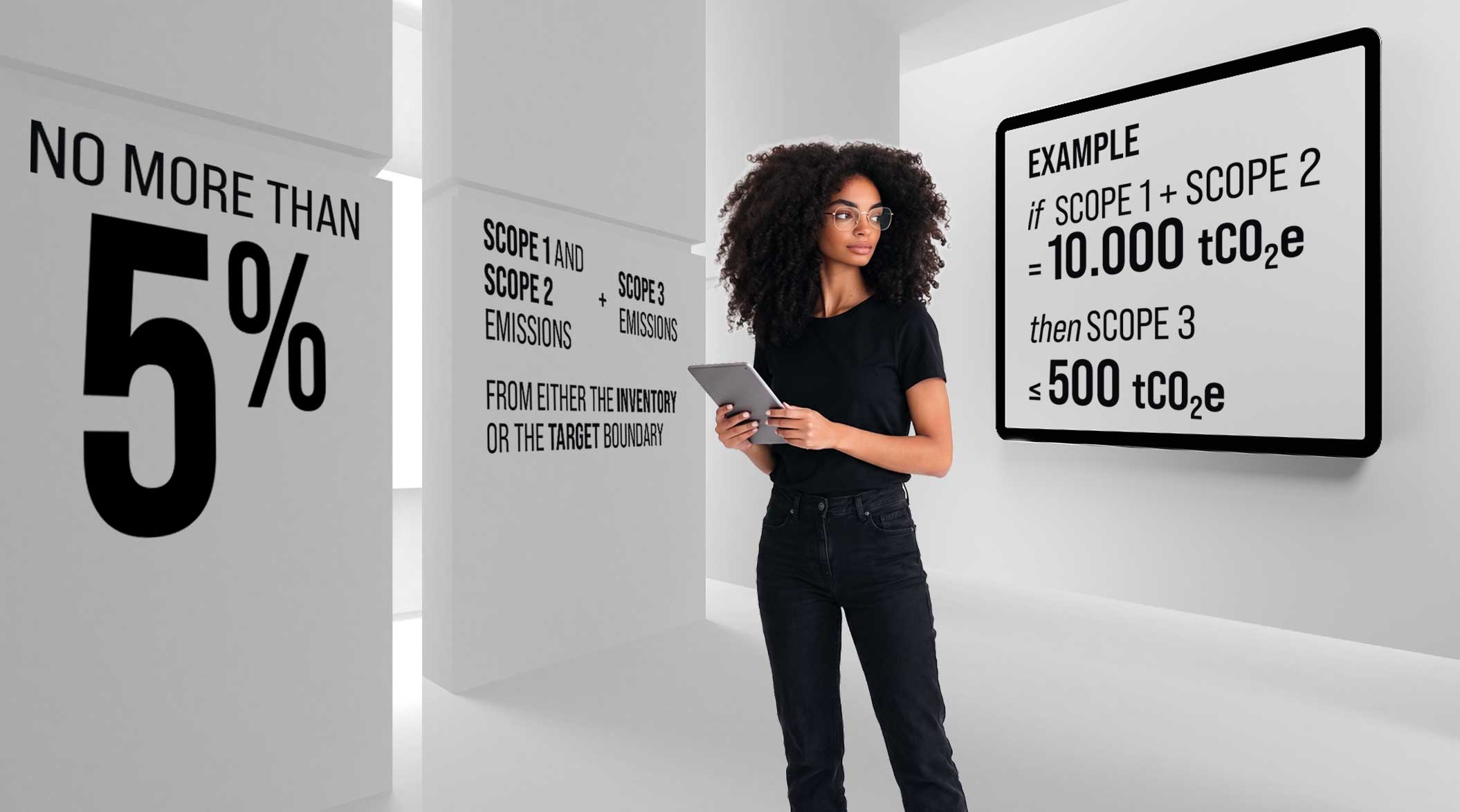
SBTi leaves little room for shortcuts. There is a specific requirement known as the 5% rule: a company cannot exclude more than 5% of its Scope 1 and 2 emissions, nor more than 5% of its Scope 3 emissions, from either the inventory or the target boundary.
In practice, at least 95% of Scope 1 and Scope 2 emissions must be included. A company cannot remove one portion from the inventory and another from the target and assume compliance. The threshold applies to total emissions, not to a conveniently omitted facility or activity.
Without this safeguard, it would be possible to “forget” an energy-intensive production line or a difficult supply chain category while still presenting an apparently ambitious climate plan. The 5% rule exists precisely to prevent such practices and ensure targets remain comparable.
A practical example: if Scope 1 and Scope 2 emissions amount to 10,000 tCO₂e, no more than 500 tCO₂e can remain outside the plan. The rest must be addressed through reduction measures. The same principle applies separately to Scope 3 emissions.
The 5% threshold also appears elsewhere. If mergers, divestments, acquisitions, or methodological changes alter base-year emissions by 5% or more, both the inventory and the targets must be recalculated. The numbers cannot remain static while the company itself changes significantly.
For those specifying materials, the rationale is straightforward. A supplier with SBTi validation cannot present a “partial” climate commitment that focuses on offices while ignoring manufacturing operations. The boundary must cover the core industrial activities that ultimately contribute to the carbon footprint of a construction project.
What Benefits Do Companies Gain from Purchasing Products from SBTi-Validated Companies or Obtaining Validation Themselves?
The market often refers to companies with SBTi validation. In reality, SBTi does not certify products; it validates a company’s climate targets. The benefits, however, are significant both for organizations that achieve validation and for those that purchase from validated suppliers.
For the company obtaining validation, the advantages are well known:
- Demonstrates a concrete commitment to sustainability.
- Enhances reputation and attractiveness to investors.
- Helps meet increasingly stringent environmental regulations.
Companies that achieve SBTi validation stand out in the marketplace and contribute to building a low-carbon future. In addition, they are better prepared for ESG questionnaires, framework agreements, and supply chain requirements. They often identify energy inefficiencies that affect both emissions and operating costs.
The picture is completed by other key tools:
- EPDs (Environmental Product Declarations) for product-level environmental data.
- CAM requirements and LEED/BREEAM protocols for public tenders and building certifications.
- SBTi validation for the credibility of the company behind the product.
For buyers, the benefits are equally tangible. Choosing a supplier with SBTi-approved targets reduces value chain risk. Emissions associated with purchased goods increasingly affect the climate accounts of clients, contractors, and asset managers. A manufacturer with a validated plan represents a more manageable and transparent link in the chain.
In Italy, CAM requirements remain the primary reference for product compliance, while EPDs remain the key document to submit. A manufacturer’s SBTi validation adds another layer of assessment: companies with independently validated targets are less exposed to weak sustainability claims and unexpected supply chain risks.
There is also a cascading effect. Many companies with Scope 3 targets require their suppliers to adopt science-based targets as well. Specifying a flooring product from an already validated company today may help avoid changing suppliers halfway through a project.
A LEED-certified headquarters or a hospital subject to CAM requirements can combine three levels of evidence: the EPD for the product’s environmental footprint, tender requirements related to recycled content and operational emissions, and the manufacturer’s SBTi validation to demonstrate that carbon reduction efforts extend beyond the technical data sheet.
A Good Starting Point, Even on Construction Sites
For companies that manufacture, specify, or purchase materials, understanding SBTi requirements means looking beyond a single environmental product metric. The management of Scopes 1, 2, and 3, emissions coverage requirements, and the 5% rule make it possible to evaluate how structured a company’s emissions reduction pathway really is and how deeply it involves the entire value chain.
In this sense, SBTi validation can complement tools such as EPDs and CAM requirements, providing an additional level of insight into the company producing the material and its broader decarbonization strategy.
CONTACT US!
"*" indicates required fields